From a sketch on a Berlin restaurant menu to a fox living on the 72nd floor — the verified stories behind London’s tallest building, and why the best way to understand it was always from the water.
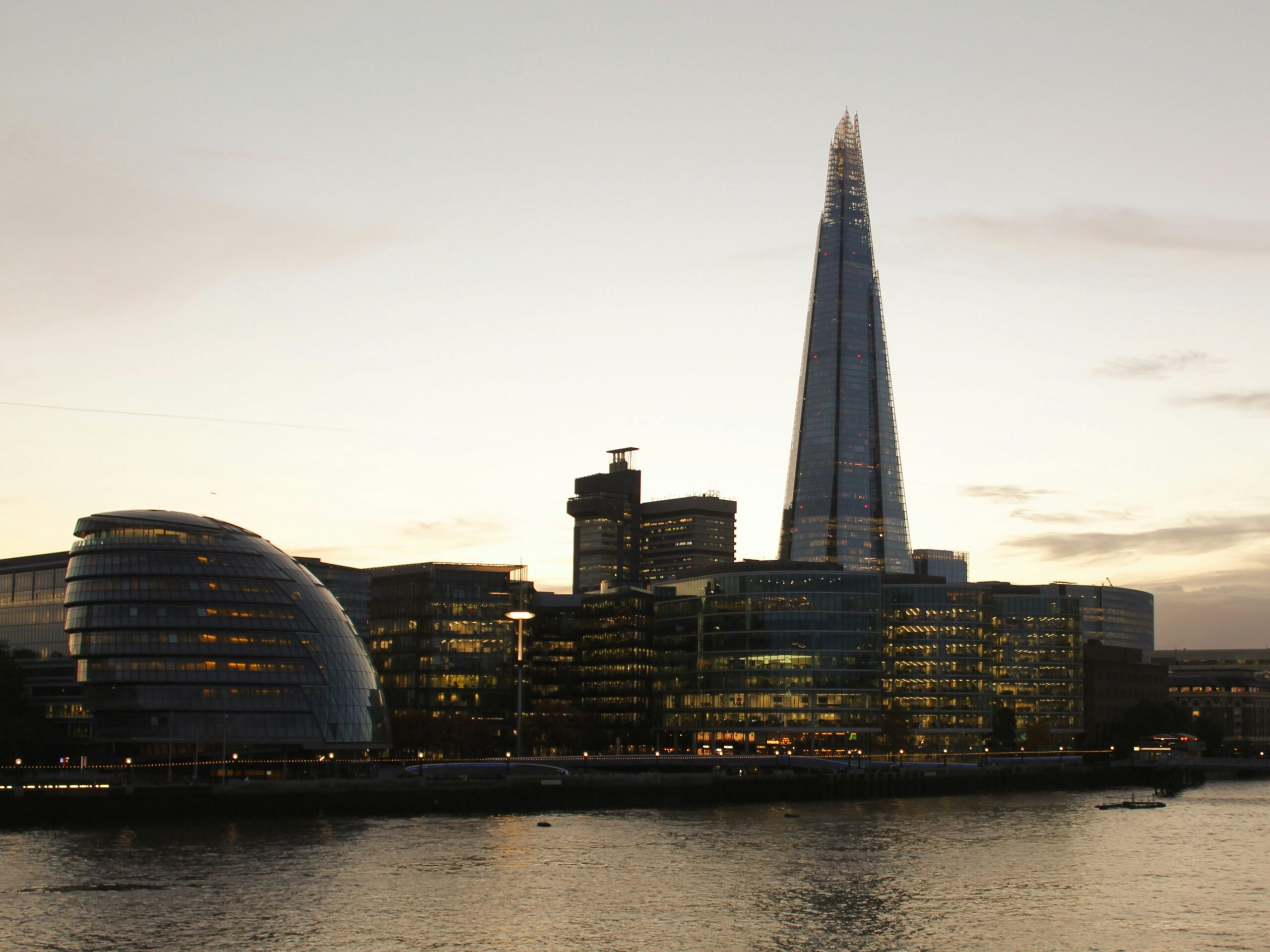
Stand anywhere along the Thames between Westminster and Greenwich and it will find you. The Shard rises 309.6 metres above the south bank, a tapering glass spire that shifts colour with the weather, the season and the angle of the light. Most people know it as the tallest building in the UK. Far fewer know the stranger, richer story of how it came to be — or why the architect always intended it to be seen from the river.
Fact 01
The name came from its critics
When plans for the tower were submitted to a public inquiry in 2002, English Heritage opposed them on the grounds that the building would be — in their words — “a shard of glass through the heart of historic London.” The phrase was intended to describe damage: a foreign object puncturing something precious and old.
The development team adopted the name immediately. It has since become one of the most instantly recognised building names in the world — a case study in the way an architectural insult, when it happens to be vivid enough, can outlast the argument it was meant to settle.
Fact 02
The whole thing started with a sketch on a menu
In the spring of 2000, London developer Irvine Sellar flew to Berlin to pitch a project to Italian architect Renzo Piano over lunch. Piano’s first reaction was not encouraging. According to Sellar, Piano told him plainly: “You know, I hate tall buildings — they are arrogant, aggressive, like fortresses.” Sellar thought it was going to be a very short lunch.
Something changed. Piano later said it was the energy of the railway lines next to the proposed site — and the Thames. He flipped over the restaurant menu and sketched a spire-like structure emerging from the river. That sketch, which Piano signed and dated “To Irvine from Renzo, May 2000 Berlin,” bears a remarkable resemblance to the building that now stands at London Bridge. Sellar told him that if he signed up, he would build it.
“I foresee the tower as a Vertical City, for thousands of people to work in and enjoy, and for millions to take to their hearts.”
— Renzo Piano, RPBW
Height
Floors
Glass panels
Construction cost
Fact 03
Piano drew inspiration from Canaletto — and from ships on the Thames
The design references Piano has cited are not modernist. He was drawn to the church spires depicted by the 18th-century Venetian painter Canaletto in his famous London views — slender, tapering structures that mediate between the ground and the sky. He was also inspired by the masts of the sailing ships that once crowded the Thames, and by the railway lines immediately adjacent to the site at London Bridge Station.
The result is a building that is, in a genuine architectural sense, in conversation with the river it overlooks. Piano described his intention as designing a “spire-like sculpture emerging from the River Thames” — and the eight sloping glass facades that define the building’s shape were designed so that the building’s appearance would change constantly, reflecting the shifting colour of the sky and the light off the water.
Fact 04
The glass facade covers the equivalent of eight football pitches
The building is clad in more than 11,000 glass panels, covering a total area of 56,000 square metres — the equivalent of approximately eight full-size football pitches of glass. Because the tower tapers as it rises, the geometry of the facade required panels of varying sizes and angles, custom-manufactured for the building. The glass was selected specifically for its diffusive quality: rather than acting as a flat mirror, it scatters and fragments light, which is why The Shard appears to change colour throughout the day — pale silver at dawn, deeper tones at dusk, a faint luminescence at night.
The facade is a double-skin design, with automatic solar blinds between the double-glazed exterior and a single-glazed interior layer — managing both light and heat without blocking the views that are central to the building’s purpose.
A different perspective
Why the Thames is the right place to see it
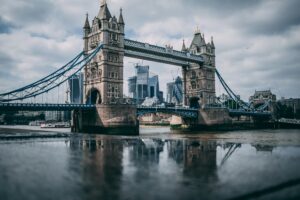
Piano designed The Shard as a sculpture emerging from the river — and no vantage point communicates that quite like the water itself. Travelling east from Westminster, the building appears gradually above the roofline, framed first by the dome of St Paul’s and then, approaching London Bridge, by the Victorian ironwork of Tower Bridge alongside the rising glass spire.
It is a composition that is very hard to replicate on foot or from a bus. From the river, you get the full vertical — the way the tower tapers to its open, unfinished tip — and the way it reflects light from the Thames on a still morning. It is the view Piano was designing toward.
Thames River Sightseeing’s cruise from Westminster to Greenwich passes directly alongside The Shard, placing it in its proper context beside Tower Bridge and the Tower of London — all visible simultaneously from the river, with live commentary from local skippers who have been navigating this stretch of the Thames for over half a century.
Fact 05
It was built using a technique new to the UK at that scale
The construction of The Shard used a method known as top-down construction: the first 23 storeys of the concrete core were built upward while the basement beneath was still being excavated downward at the same time. According to the engineers involved, this technique had not previously been used for the core of a very tall building in the UK, and it allowed the construction programme to be completed three months ahead of schedule, keeping the total cost under the revised budget of £435 million.
At the peak of construction, 1,450 workers from 60 countries were on site simultaneously. The project was completed in 38 months and topped out on 30 March 2012, when its 66-metre, 500-tonne steel spire was winched into place.
Fact 06
A fox moved into the 72nd floor during construction
Towards the end of construction, a fox was found living on the 72nd floor of the unfinished building. The animal — nicknamed Romeo by site staff — is believed to have made its way up through one of the stairwells and survived on food scraps left by construction workers. It was found well-fed and in good health.
The 72nd floor, which later became The Shard’s open-air observation deck — the highest public viewing point in the UK — was at that point still an exposed steel structure, open to the elements hundreds of metres above London. Romeo’s residency is, in a small way, the most improbable footnote in the building’s construction history.
Fact 07
It deliberately has no enclosed top
One of the most intentional features of The Shard is its open apex. The eight glass facades simply taper toward a point and stop, leaving the structural steel exposed to the open air. Rain, wind, and mist move through the uppermost section of the building freely. This was not a cost decision or a structural compromise — it was central to Piano’s design intention.
He described wanting the tower to appear to dissolve into the sky rather than terminate against it. The Shard’s own description of the spire reflects this: it is designed to taper off and “disappear into the sky.” In certain weather — particularly on overcast or misty days — the effect works exactly as intended. The tip of the building becomes almost invisible, appearing to merge with the cloud above it.
Fact 08
It is a vertical city with distinct uses stacked floor by floor
Piano described The Shard from the outset as a “vertical city” — not a single-purpose office tower, but a building that would contain the full range of an urban neighbourhood, stacked one use above another. That description reflects the actual layout of the building precisely.
Offices occupy floors 2 to 28. Three restaurant floors follow — 31, 32 and 33, home to Oblix, Hutong and Aqua Shard. The Shangri-La Hotel takes up floors 34 to 52. Above that, private residences occupy floors 53 to 65 — the highest homes in the UK. The View from The Shard observation gallery sits on floors 68, 69 and 72, with the open-air Skydeck at the very top of the habitable structure, 244 metres above street level.
Fact 09
It is the tallest building in the UK and Western Europe
At 309.6 metres, The Shard is the tallest building in the United Kingdom and Western Europe. From the open-air Skydeck on the 72nd floor, at a height of 244 metres, visitors can see for up to 40 miles on a clear day. That view takes in six counties. The distance to the horizon from that height — calculated on the curvature of the earth — is approximately 56 kilometres.
The building is visible from remarkably far outside London, including from elevated sections of roads in Surrey and Kent. At night, its aircraft warning lights make it a navigational reference across a wide arc of the city. On overcast days, when low cloud rolls in from the Thames estuary, the building can appear to be cut in two — only its lower section visible below the cloud base, floating above the city with no apparent top.
Fact 10
It was funded almost entirely by Qatar — and nearly wasn’t built at all
The Shard is jointly owned by Sellar Property (5%) and the State of Qatar (95%). That outcome was far from inevitable. In late 2007, as global financial markets destabilised, the project came close to being abandoned altogether. In January 2008, a consortium of Qatari investors stepped in, paying £150 million to secure their stake and making construction possible at a moment when most London developments were stalling or collapsing entirely.
The building was formally inaugurated on 5 July 2012 by the Prime Minister of Qatar, Hamad bin Jassim bin Jaber Al Thani, in a ceremony attended by Prince Andrew, timed to coincide with the London Olympics. The sovereign wealth funding that saved the project is precisely why The Shard was built faster and under budget: decisions that would have required months of bank approvals were made directly and quickly, keeping the construction programme on track.
Seeing it in context
The Tower of London, Tower Bridge, and The Shard — from one boat
The stretch of the Thames between London Bridge and Tower Bridge concentrates nearly a thousand years of London’s built history into a single kilometre. The Tower of London — begun by William the Conqueror around 1078 — sits approximately 900 metres from The Shard. Tower Bridge, opened in 1894, stands between them. From street level, the sightlines between these three landmarks are broken by buildings, roads and the riverbank. From the water, the composition resolves entirely.
The Thames River Sightseeing cruises running between Westminster and Greenwich — a family-run operation with more than 50 years on the river — pass through this corridor on every sailing. It is, without question, the most historically dense river view in the country. The boat does not rush it.