There is something about the River Thames that filmmakers cannot resist. It has been a backdrop since the very earliest days of cinema — in July 1896, the Victorian pioneer R.W. Paul positioned his camera at the southern end of Blackfriars Bridge to record people and horse-drawn traffic crossing the Thames, a film preserved to this day in the BFI archive. Over the following century, the river became one of the most filmed waterways on earth. Spies have chased each other along it, Death Eaters have destroyed its bridges, and Tom Cruise has sprinted across one of them.
What follows are some of the most iconic Thames moments on screen.
James Bond and the Longest Pre-Credit Sequence in 007 History
No film has used the Thames more spectacularly than The World Is Not Enough (1999). The movie opens with Pierce Brosnan’s Bond commandeering an experimental Q Branch jet boat from MI6 headquarters at Vauxhall and launching into a full-speed chase downriver — past the Houses of Parliament, through a riverside restaurant, and all the way to the then-brand-new Millennium Dome at Greenwich.
The sequence runs for fourteen minutes, making it the longest pre-credit sequence in James Bond history at the time of release. Filming took place on the Thames between 29th March and 7th May 1999, with six weeks of shooting on the river and more than two months of stunt rehearsal beforehand. Thirty-five boats were used across the production. The spectacular mid-air barrel roll — achieved by stuntman Gary Powell using Vickers air mortars attached to the side of the boat — was captured by six cameras simultaneously and remains one of the finest stunt sequences in the Bond franchise.
One behind-the-scenes footnote: when the chase reached the Houses of Parliament and a Parliamentary Committee raised a complaint about what sounded like gunfire nearby, it turned out the noise was from pile-drivers constructing the London Eye, which was still being built at the time and does not appear in the film.
Those passing through Westminster and Greenwich on a Thames River Sightseeing cruise are following almost exactly the same route as Bond’s Q Boat — just rather more legally, and at a considerably more relaxed speed.
Harry Potter and the Wobbly Bridge
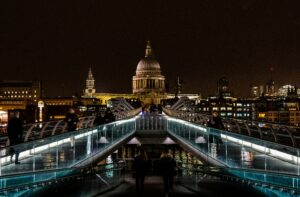
The opening sequence of Harry Potter and the Half-Blood Prince (2009) is one of the most striking uses of the Thames in modern cinema. The Death Eaters sweep over London, and the Millennium Bridge — the sleek pedestrian crossing connecting St Paul’s Cathedral to Tate Modern on the South Bank — buckles, twists, and plunges into the Thames.
The scene was deliberately set on this specific bridge. Director David Yates chose to replace the fictional “Brockdale Bridge” from J.K. Rowling’s novel with the Millennium Bridge because it would be immediately recognisable to audiences — and because there was a certain dark humour in choosing a bridge that had famously wobbled and been forced to close just days after its opening in June 2000, earning the nickname “the Wobbly Bridge.” The destruction was entirely CGI: the real bridge was filmed in March 2008, with visual effects company Double Negative spending six months documenting and surveying the surrounding Thames environment to create the digital sequence.
Harry Potter’s connection to the Thames doesn’t end there. In Harry Potter and the Order of the Phoenix (2007), Harry and members of the Order fly on broomsticks over the river at night, passing HMS Belfast and Tower Bridge. Both are visible on a Thames River Sightseeing cruise.
28 Days Later: An Empty Westminster Bridge at Dawn
Few images in British cinema are as haunting as the opening of Danny Boyle’s 28 Days Later (2002): Cillian Murphy’s character Jim waking from a coma in St Thomas’ Hospital and walking across an entirely deserted Westminster Bridge, with the Houses of Parliament and the Thames stretching out before him in eerie silence.
Achieving this required filming in the early hours of the morning before the city became too busy to hold back traffic. As location manager Alex Gladstone later explained: “We shot on a weekend and got there super-early to capture that moment. When you see the whole of Westminster Bridge and the embankment all closed for you, and the traffic stopped, and you can’t hear anything, it was thrilling but strange as well.” The crew had, in his words, only an hour or so before the city became impossible to control. Small, lightweight Canon XL1 digital video cameras — far more manoeuvrable than traditional film cameras — were crucial to making such brief shooting windows work.
It remains one of the most extraordinary location achievements in recent British filmmaking.
Mission Impossible: Fallout — Tom Cruise Runs Across Blackfriars Bridge
Tom Cruise performs his own stunts, and the chase sequence filmed on and around Blackfriars Bridge for Mission Impossible: Fallout (2018) is a confirmed example. Cruise — as Ethan Hunt — can be seen sprinting across the bridge in one of the film’s central action sequences, with St Paul’s Cathedral visible behind him.
The current Blackfriars Bridge was designed by Joseph Cubitt and opened by Queen Victoria on 6th November 1869, replacing an earlier stone structure from 1769. It sits between the Southbank arts complex to the west and the City of London to the east, making it one of the most cinematic river crossings in the capital.
Spider-Man: Far From Home — The Battle of Tower Bridge
Marvel brought its biggest London sequence to Tower Bridge in Spider-Man: Far From Home (2019), with Peter Parker confronting Mysterio in the film’s climactic battle. The sequence uses Tower Bridge as its principal landmark with the surrounding Thames as backdrop.
Tower Bridge was built between 1886 and 1894 — eight years of construction — and opened by the Prince of Wales on 30th June 1894. Its distinctive bascule-and-suspension design, with its twin Gothic towers, has made it the single most filmed piece of infrastructure in London’s history.
Back in Action: One of the Most Ambitious Thames Stunts in Recent Memory
Released on Netflix in January 2025, Back in Action — starring Jamie Foxx and Cameron Diaz — features one of the most ambitious stunt sequences ever filmed on the Thames. Filming took place between December 2022 and January 2023, largely at night and in freezing conditions.
The production required several closures of the river, as well as the temporary closure of Millennium Bridge and Southwark Bridge. A motorbike chase was filmed on the Thames foreshore along the South Bank, running all the way down to the Thames Barrier via Butler’s Wharf. The river chase reached speeds of over 40mph — exceptionally rare for any vessel on London’s regulated waterways. A fleet of more than twenty boats was involved in the production. In preparation, the marine team taught Cameron Diaz to drive a boat on the Thames.
The Long Good Friday: The Thames as London’s Underworld
Before Bond, before Harry Potter, there was The Long Good Friday (1980) — ranked 21st on the BFI’s list of the 100 greatest British films and holding a 97% approval rating on Rotten Tomatoes. It is widely considered one of the finest British crime films ever made and one of the most vivid portraits of London in cinema.
Bob Hoskins plays Harold Shand, a London gangster whose empire begins to unravel over a single Easter weekend. Much of the film is set on and around the Thames, particularly at Limehouse Marina and the Royal Docks — an area that at the time of filming was derelict, scarred by the collapse of London’s old shipping trade. The central plot concerns Shand’s attempt to persuade American mobsters to bankroll his redevelopment of the Docklands, with an eye on a potential London Olympic bid. It was a bid that never materialised in the form Shand imagined — but London did eventually host the Games, in 2012.
Alfred Hitchcock and the Thames Tradition
Alfred Hitchcock — born in Leytonstone, east London — used the Thames and its surroundings extensively in his early British films, helping establish a template for location-based London filmmaking that directors have been following ever since.
Blackmail (1929), his first sound film, was largely shot in London and made imaginative use of the city’s landmarks. It was Hitchcock who, more than any director of his era, recognised the Thames — its embankments, bridges, and fog — as a ready-made dramatic backdrop. The BFI credits him with beginning the tradition of using London’s riverside landmarks for suspense films, a tradition that runs directly through to Bond chases, Harry Potter sequences, and Marvel action set pieces today.
The River That Always Stars as Itself
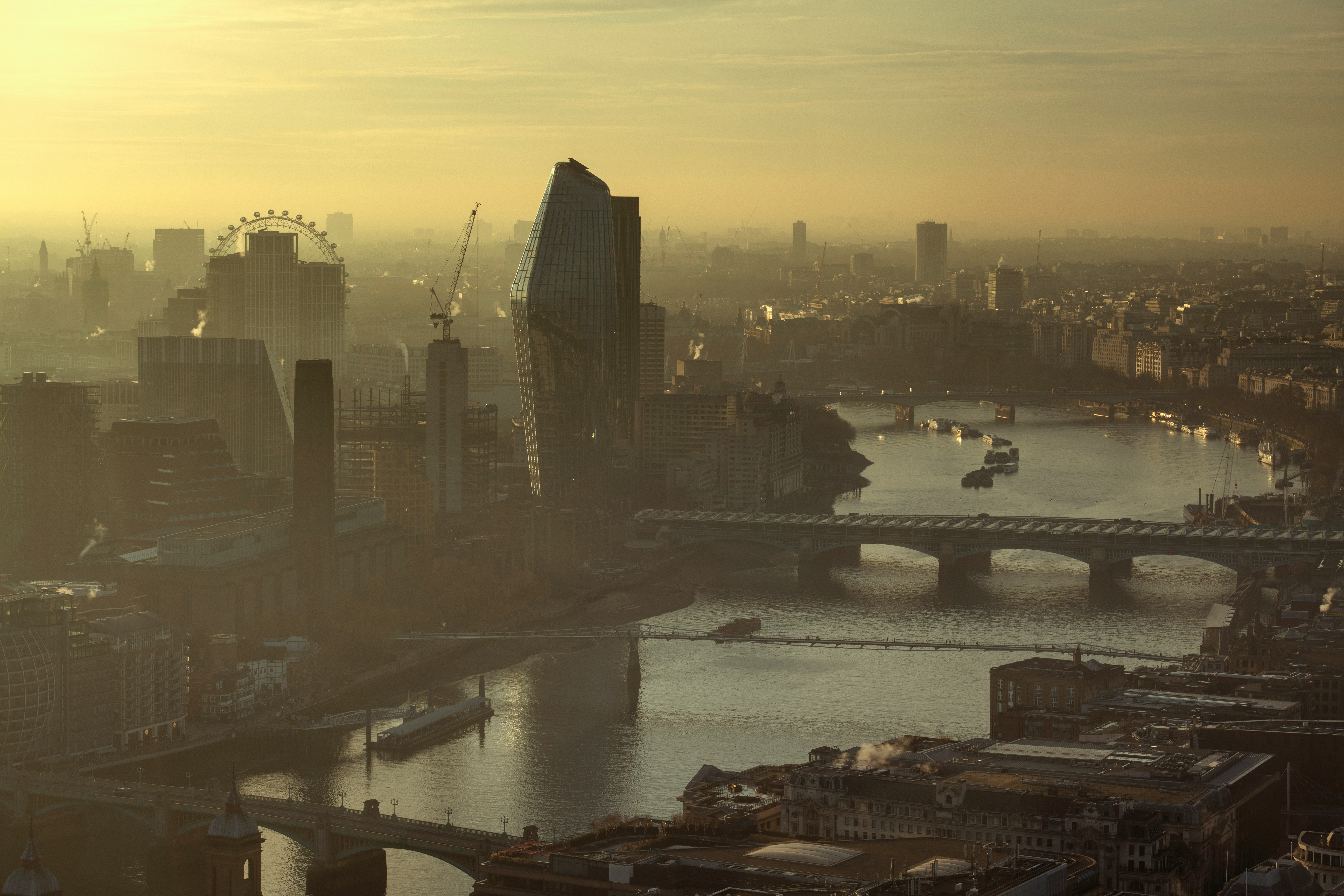
What makes the Thames so consistently compelling on screen is that it doesn’t need to pretend to be anywhere else. Unlike many cities where filmmakers disguise locations or use one street to stand in for another, the Thames is always unmistakably itself — the Houses of Parliament on one bank, the South Bank on the other, Tower Bridge exactly where it has always been.
Almost every one of these scenes was filmed on the same stretch of water you sail through on a Thames River Sightseeing cruise. The Millennium Bridge the Death Eaters brought down. The deserted Westminster Bridge that opened 28 Days Later. The Tower Bridge where Spider-Man fought Mysterio.
The river looks exactly the same.